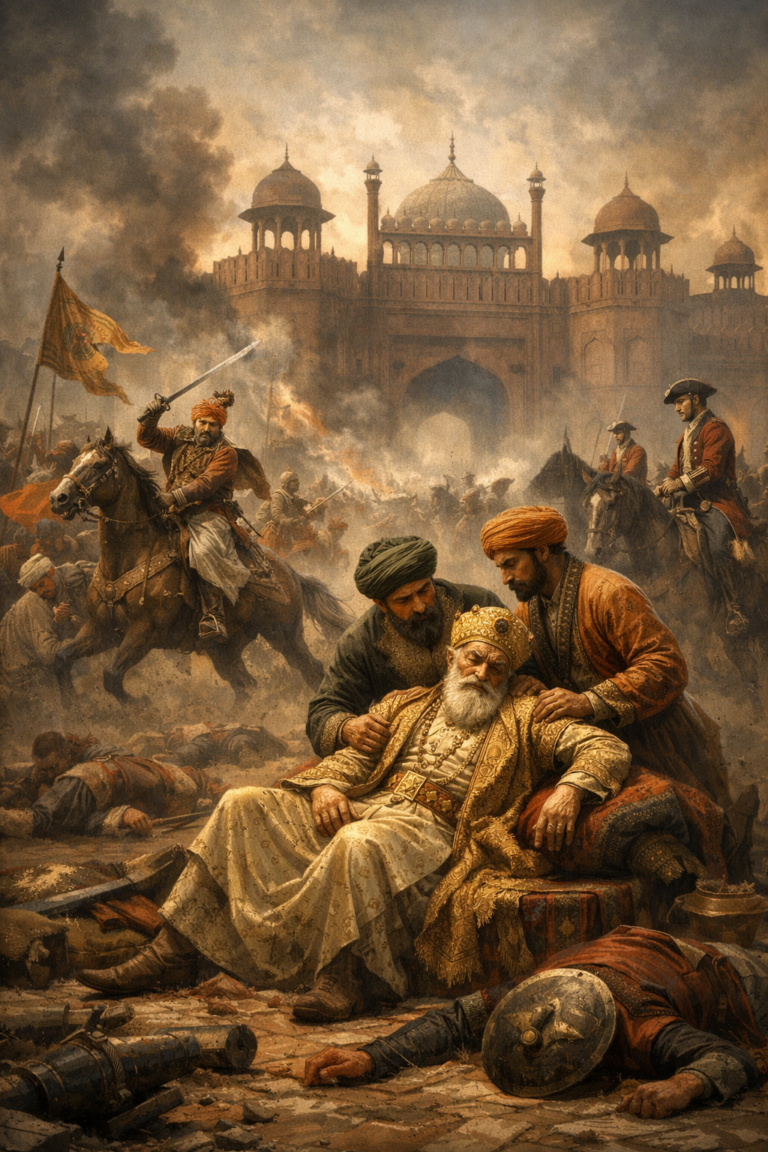
The Decline of Mughal Empire (1707 – 1750) : Causes, events and its Role in Shaping the History of Modern India

The period between 1707 and 1750 marks a crucial transitional phase in Indian history because of Mughal empire’s inevitable decline. This period created a bridge between medieval India and early Modern India leading to European political dominance. The causes behind decline of Mughal Empire explains the conditions for the rise of regional powers and what enabled colonial expansion. The decline of the Mughal empire wasn’t a sudden collapse instead it was a slow process influence by social, political, economic and military factors. 
 

Introduction: Why is the decline of Mughal empire important

Mughal empire was once at it’s Zenith under the rule of Aurangzeb and the rulers before him. It was one of the strongest empire in the world, covering most of Indian subcontinent. However after the reign of Aurangzeb it gradually began to decline due to many possible reasons which we will discuss further. Studying the decline is essential to understand how India got divided into political fragments and got strangled at the hands of Britishers. 

Background: The Mughal Empire at Its Peak

The Mughal empire was known for its centralised administration, military strength and economic prosperity. Under rulers like Akbar, Jahangir, Shah jahan and Aurangzeb, the empire expanded culturally as well as territoriality. The imperial control was further supported by efficient revenue system and a strong nobility. As every coin has two faces, the empire also had it’s weakness which became evident after Aurangzeb’s death. 
Aurangzeb’s death in 1707 was a turning point  in the history of Mughal empire as it lost it’s stability. He ruled for almost 50 years and maintained administration and military campaigns. After that became the line of weak rulers who were not able to administer such a vast empire. His death became the last straw that started the decline of the empire. 
 

Major Causes Behind The Decline of the Mughal Empire:

War for Succession and weak rulers

During the reign of Shah Jahan history its first war of succession in the Mughal empire among Shah Jahan’s children. This became a ritual under each ruler. The frequent wars and change of rulers drained the empire’s resources and weakened its stability. Bahadur Shah I and his successors lacked strong leadership skills and were unable to control the strong nobles. The constant struggle for power and throne made the central administration weak and ineffective that encouraged regional kingdoms to bloom and assert dominance. 

Corruption and nobility

Due to corruption and rivalry among nobles, the Mughal administration suffered. The corrupted Mansabdars prioritised personal gain over imperial loyalty. Inefficiency, bribery and internal factionalism weakened empire. As nobles fought among each other for power and influence, the emperor’s authority declined further. The administration’s breakdown directly affected revenue collection and law enforcement, which made it almost impossible for the weak emperor to maintain order and control over vast territories. 

Economic Decline and Revenue Crisis

Wars, extravagant courts, monuments, administrative inefficiency med to severe financial strain. Due to unrest among peasants, heavy taxation and due to neglect agricultural productivity declined. The Jagirdari system became unstable due to corrupted officials and taxation. The Mughal state struggled to maintain its army and administration because of the reduced income. 

Weak military and outdated warfare

The military system was outdated by the early eighteenth century. On the other hand Europeans has modernised their armies with better weapons and techniques. The depletion of royal treasury also affected the efficiency of the military. The lack of innovation, poor coordination and declining morale weakened the army. 

Key events for the decline of the Mughal Empire:

Rise of Regional Powers

As Mughal empire weakened the region states started asserting their independence. The Rajputs, Marathas and other powerful kingdoms started putting pressure on the Mughals through wars and raids. This also created a gap in the central administration through which Britishers were able to come through and give the last blow to the Mughal empire. 

Foreign invasions

Foreign invasions like Nadir shah’s invasion in 1739 was devastating, leading to massive destruction in Delhi which also resulted in loss of imperial prestige. Similarly Afghan invasions added to instability. These invasions showed that Mughal empire could no longer protect their territories. 
 

European influence

The growing European influence of trading companies, especially the British and French, weakened mughal authority. These companies started interfering in local politics by supporting rival rulers. The weakening Mughal authority helped them in gaining privileges and territorial control. 
 

The Decline of Mughals shaped the Early Modern History of India:

The decline shaped the India’s political structure from centralised imperial control to fragmented regional control. This made it easy for the Britishers to pick each fragment one by one and put them under their control. Their was no unified front among the regional rulers which created a power vacuum which Britishers exploited. This period laid down the ground work for the colonial rule and marked the transition from Medieval to Modern Indian history.

Conclusion:

The decline of the Mughal empire was not merely a fall of a dynasty but a turning point in Indian history. It reshaped governance, weakened Indigenous power and unity and opened doors for colonial rule. Understanding the decline provides essential context for later developments in Modern Indian history. 

Leave a Comment

Your email address will not be published. Required fields are marked *

Scroll to Top