
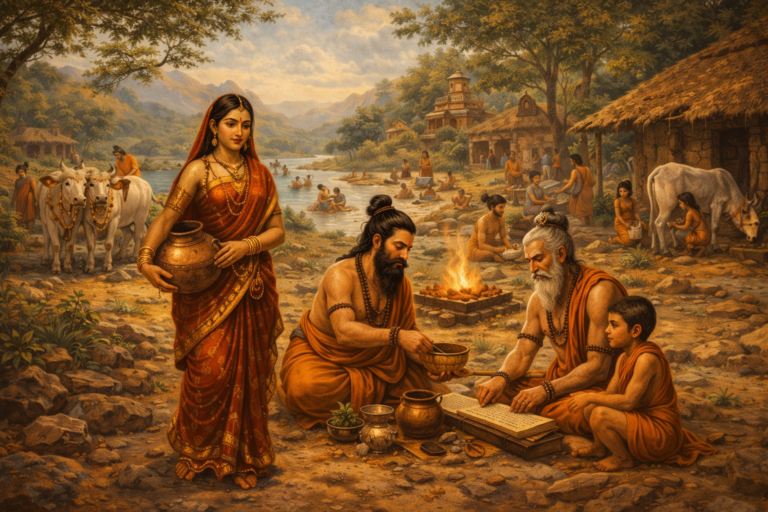
Introduction to Early Vedic Period:
The Early Vedic period is the most important phases of Ancient Indian History. It marks the beginning of Vedic Civilization and laid the foundation for Indian culture, religion, society and social organisations. We know abput this period through the Rig Veda.
The Early Vedic period is generally dated between 1500 B.C.E. – 1000 B.C.E. The beginning of Early Vedic society is marker with the arrival of Aryans in north-western India. During this period people lived mostly in Sapta – Sindhu region (land of seven rivers) which included Indus and its tributaries.
Sources of Early Vedic Society:
Rigveda:
The major source of knowledge of that time is Rigveda. It consisted of 1028 hymns and 10 mandals. The famous Gayatri mantra is found in the 3rd Mandala. The hymns were transmitted orally for centuries, later on the Rigveda and other three Vedas were composed. Early Vedic Society was based on Rigveda. Although the Rigveda is not considered a historical document but the references written in it help in gathering background historical knowledge and understanding the chronology of the time.
Political History of The Early Vedic Period:
The political structure of the Early Vedic society was kin–based and tribal. People identified themselves by tribal associations rather than by territory. The basic political unit was called Jana(tribe). Rigveda mentions following tribes: Bharatas, Purus, Yadus, Turvasas etc. The head of each tribe was Raja/Rajan (king or chief). His most important responsibility was protecting the people, leading them to war and maintaining social order. He was supported by two types of meeting:
Sabha: only elder official people were included to discuss important topics in this council.
Samiti: All people of the tribe including commoners were part of discussions.
Economy of The Early Vedic Society:
The Early Vedic society was primarily Pastoral. Cattle were the main measure of wealth and played an important role in religious life. The Rigvedic word Gavishti literally means “search for cows” which suggests that sometimes conflicts used to happen because of cows. Some occupations mentioned in Rigveda are – Cattle rearing, agriculture, weaving, pottery, trading based on barter system etc. There is no evidence of coins found from that period.
Social Life of Early Vedic Society:
Family(kula) was the most smallest unit of society. They were patriarchal in nature. The father was the head of the society and took important decisions for the family. Although patriarchy was common women enjoyed equal rights and freedom as men. Monogamy was the basis of society and polygamy was uncommon. Joint families were common and respect for elders was emphasised. A group of families formed a Grama(village). Many Gramas formed a Vis(clan). Clans came together to make a Jana(tribe) which were under the authority of Raja.
Status of Women in the Early Vedic Society:
Women in early vedic society enjoyed high status. No rituals can’t be performed by the husband without his wife. They had equal rights to education and participation in activities of the society. Several women sages such as, Gargi, Lopamudra and Apala are credited with composing hymns in Rigveda. Women had rights to attend assemblies, arrange Swayamvars(choose their own husband) (not confirmed but hinted at) and even remarry in certain circumstances. Practices like Sati, child marriage and Purdah system were unknown.
Religious Beliefs of the Early Vedic Society:
Religion was nature-centred, ritualistic and simple. People worshipped forces of nature, personified as Gods. Important Gods included:
- Indra: god of thunder and war; the most popular diety
- Agni: God of fire and intermediary between gods and humans.
- Varuna: guardian of cosmic order (rita).
- Soma: Associated with sacred ritual drink.
There were no temples. Worship included sacrifices(Yajnas) performed in open usually by the head of the household. No dominance of Priestly class is observed during this period.
Conclusion:
The Early Vedic society represents a flexible, dynamic and egalitarian phase in Ancient Indian History. It is marked by tribal organisation, pastoral economy, political institutions and nature based religious beliefs. social divisions were present were not rigid. Women enjoyed a comparative high status.
Over time Aryans moved eastward towards fertile Gangetic plains, agriculture expanded, population increased, and social structures became more complex. this transition led to emergence of Later Vedic Society.
Understanding Early Vedic Society is essential for comprehending the evolution of Indian civilisation, as it laid the foundation of social, cultural and religious patterns that would shape the subcontinent for centuries to come.