
Welcome To 2500 BCE: A Day In Indus Valley Civilisation
Alright, picture this: it’s 2500 BCE, and you’re just roaming, foraging and wandering around with your family in the outskirts of western Asia. Out of nowhere, everyone decides to set up camp by a river ’cause it’s fertile and full of life – And yes, they totally didn’t ask you first! It’s like being that middle kid who always gets left out of the family plans.
Urban Planning And Architecture – Houses, Streets, Drainage and Buildings
Now that everyone has settled down they decided to build a city – Not just any city – THE FIRST URBANISATION.
City Layout – Grid System and Drainage
So, in this new city the houses are one to two stories with bathroom attached to them. The roads cut each other at right angles and open to a broader road that can be said to be a main road – A GRID SYSTEM. The houses were made of sun dried baked bricks! The bricks were laid in English bond style. The size of the brick was uniform in ratio 1:2:4 – thickness, width and length.
Another interesting thing about the city was their sophisticated drainage system. Every house wasn’t just build with a bathroom and the waste water didn’t just go anywhere. It was connected to private drains which were further connected to a larger main drain running along the streets. These drains were made of baked bricks as well with manholes and inspection points. The drains were covered by corbelled arches made of stone slabs to prevent health hazards.
The Great Bath And Granary
People around you were simple minded like your millennial parents who doesn’t understand the natural vibe of the things around you they constructed a big swimming pool like structure for ritualistic purpose known as The Great Bath. The bath got it’s water from a nearby well and the dirty water was emptied through drains into the city’s sewage system. The great bath: Wash your BODY and Your SOUL..
Living by a river is great since it means you’ve got extra food, but to maintain that figure, you’ve got to watch how much you eat. That leftover food? It gets stored into a ‘Big Granary’. It had small air ducts to provide ventilation.
Citadel And Lower Town
Like every society the city was divided into two parts the upper part for wealthy people and the lower part for peasants and the commonly known as middle class people like us. The upper part was known as citadel. It was a raised fortified area. Important places like great bath, granaries etc. We’re located in this area. The lower part was called lower town or lower city because of low lying area. Point to note is that there was no caste system like later Hindu societies. (Historians have used the words like middle class and peasants or elite to explain the differences among two sections.)
The Granary and the Great bath were also part of citadel – the fortified structure used to protect us from floods and from the most inhumane animals on earth- humans.
Cities Of Indus Valley Civilization:
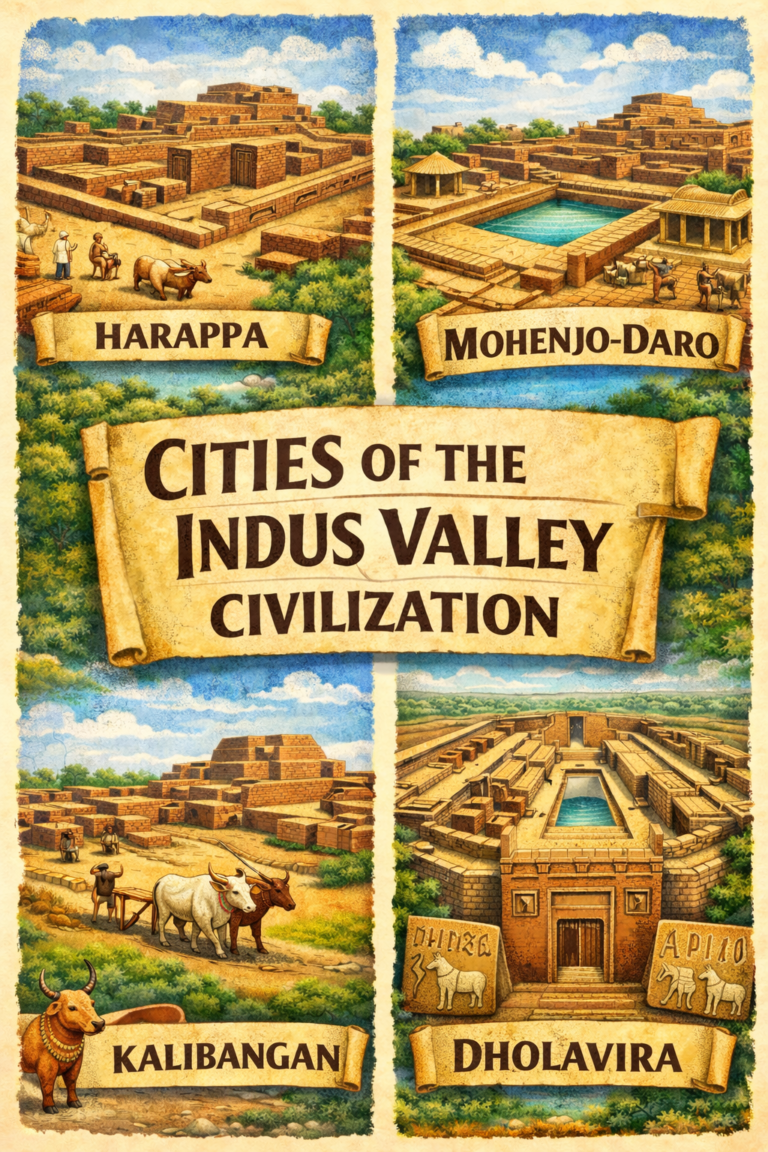
Mohenjo-Daro
The city was named Mohenjo-Daro often translated to mound of the death (sounded gothly aesthetic at that time). It was discovered by R. D. Banerjee.
It wasn’t just a city it was the OG city of the ancient world. The city was properly divided into proper blocks with clean, straight, proper and zero chaos roads. Everything was professional like someone actually sat down and drew it instead of winking it.
It had both one storey to two story houses. Rich people lived in bigger houses and had courtyards (flexing since 2500) and the middle class lived in simpler houses but both had proper drainage system and basic facilities – equality but with a budget.
Drainage system was well maintained, putting many modern cities to shame. Basic civic facilities like proper housing, clean streets etc. weren’t a luxury; they were normal life.
At the heart of city was the Great Bath. It also had granaries and citadel. It did not had big statues saying “I am the king”. Everything seemed strangely practical and equal.
Now the question arises how was it so well maintained? Who was running the city? How did everyone agree on such discipline without anyone showing off power?
And that’s exactly how Mohenjo-Daro still messes with historians’ head.
Harappa: The Name Giver
While Mohenjo-Daro was the main attraction but Harappa was literally so important that civilization is named after it.
It was similar to Mohenjo-Daro in every way but will other were flexing there buildings, Harappa was the one handling logistics and management. It was big, well planned and screamed business.
Dholavira – The Water Reservoir
Main slogan of DHOLAVIRA was “save water: It gives us life”
DHOLAVIRA had big reservoirs for water conservation. The city had channels and drains to save every last drop of rainwater in big tanks carved in the city.
Today, while most cities are facing water problems this city was so ahead of it’s time to face any water shortage challenge.
The people of ivc were environmentally aware way before it became trendy
Kalibangan: Rituals and Fire city
The most important feature of the city were it’s fire alters suggesting people were interested in rituals and religious practices.
Archaeologists have also found evidence of plough fields – agriculture was taken seriously and new the basics of farming.
Chandudaro : The craft hub
If this city existed today it would be the most trendy place on Instagram because of it’s art aesthetics. It had bead making industries, shell works and craftsmanship. It thrived on skilled labor and trade.
Lothal: Harbor and Trade
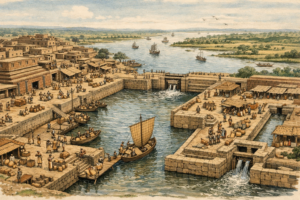
Most interesting city by far has to be Lothal, because that’s where you’re going to meet your foreign lover who found your letter sealed in a bottle that you tossed out to sea when you were 5 years old. Your lover’s finally here, and she’s been dreaming about you since that day in Mesopotamia! But hey, stop daydreaming; it used to be a port city where people from civilizations all around the world came to trade.
Lothal proves that ivc wasn’t isolated but was globally connected long before globalization was even.
Trade Without money: Barter system and Seals
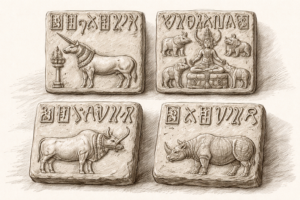
Well, there was no currency to buy anything. Guess what! Seals were used in barter system to trade precious stones, gems, metal and even grains. Seals were made of steatite.
These seals had images of God’s – Pashupati Nath (a premature version of Lord shiva) or Mother Goddess similar to Goddess durga and even animals and symbols.
Trade Without money: Barter system and Seals
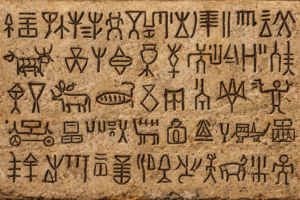
It’s like those doctor scribbles that nobody can read—kind of like the secret love letter written in codes that no one should see… the script of this civilization is still a mystery!
It is written in logo-syllabic system meaning, it probably had symbols representing words and sounds. It is written in right to left direction though some inscriptions are bidirectional.
About 400-500 signs and symbols have been found. These are written on pottery, seals, tablets, amulets and copper objects.
A Mysterious Death
Lastly, prepare for untimely death of your civilization. Most historians claim a flood came that destroyed it yet some suggested that your people fought Aryans who came to your city and next thing you know you were shoved around like those bullies in k dramas. Some historians also believe that climate change was one of the reasons.
The truth is still debated and no theory explains everything.
Silent witnesses of the Indus Valley Civilisations
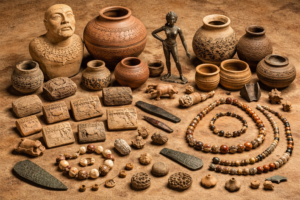
Many voices echo beneath the buried baked, bricked-walls of Indus Valley Civilization. They speak through the Bronze Dancing Girl froze mid step, te calm of the stone face of The Priest or by the beads made up of carnelian, lapis lazuli, shell and gold found in cities that were once in the hands of some young girl, forgotten in the pages of history. Many potteries, utensils, tools, toys and weights have also been found carrying the whispers of trade, belief and daily life. Among them drains, wells, granaries and planned streets stand in silence- proof of what is left behind.
The Legacy of Indus Valley Civilisation
If we are ever able to decipher the Harappan script we might come to know more about this ancient civilization and maybe finally we can discover the truth about how such an advanced , architecturally sophisticated, culturally refined and thriving civilization met it’s untimely mysterious death.
Until then, it remains one of the most impressive yet puzzling part of the ancient world.
-A